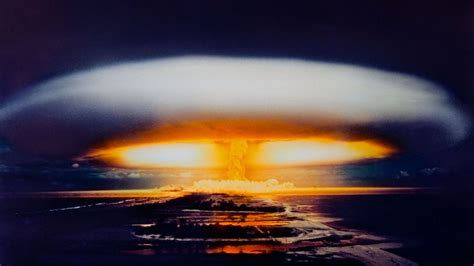
Unveiling the World’s Most Powerful Nuclear Weapons\n\nHey guys, have you ever stopped to think about the sheer,
unfathomable power
locked within the
world’s most powerful nuclear weapons
? It’s a pretty heavy topic, no doubt, but understanding these titans of destruction is crucial for anyone interested in global security, history, and the future of our planet. When we talk about nuclear power, we’re not just discussing energy; we’re delving into a realm of capability that can reshape landscapes and alter human civilization in an instant. From the very first atomic blasts to the incredibly sophisticated, multi-megaton warheads developed during the Cold War and beyond, the evolution of these weapons marks a significant, and often terrifying, chapter in human ingenuity. The implications of possessing, or even just
knowing about
, these
strongest nuclear weapons
are vast, touching upon international relations, military strategy, and the very ethics of warfare. It’s a subject that demands our attention, not just out of morbid curiosity, but out of a genuine need to comprehend the forces that shape our geopolitical landscape. We’re going to dive deep into what makes these weapons so potent, examining not just their destructive yield but also the historical context, the scientific principles, and the chilling humanitarian consequences that make them the ultimate deterrent – or the ultimate catastrophe. So, buckle up, because we’re about to explore the awesome, terrifying reality of the planet’s most formidable creations, keeping a casual yet respectful tone as we navigate this complex and vital subject.\n\n## The Dawn of the Atomic Age: A Historical Perspective\n\nTo truly grasp the concept of the
world’s most powerful nuclear weapons
, we absolutely have to start at the beginning, guys – the dawn of the atomic age. This wasn’t just another technological leap; it was a fundamental shift in humanity’s destructive potential, marking a point of no return. The story begins, famously, with the
Manhattan Project
, a top-secret endeavor during World War II involving thousands of scientists and engineers from the United States, with significant contributions from the UK and Canada. Their mission: to harness the immense power of nuclear fission before Nazi Germany could. It was an urgent race against time, driven by scientific breakthroughs in understanding the atom, particularly Einstein’s mass-energy equivalence principle (E=mc²), which hinted at the colossal energy stored within matter. On July 16, 1945, the world witnessed the first successful detonation of a nuclear device, code-named ‘Trinity’, in the New Mexico desert. The sight was unprecedented – a blinding flash, a colossal mushroom cloud, and an incredibly powerful blast wave that forever changed warfare. Just weeks later, on August 6 and August 9, 1945, the cities of
Hiroshima and Nagasaki
experienced the devastating reality of these new weapons. The bombings, carried out by the United States, instantly killed tens of thousands and left a lasting legacy of suffering and destruction. These events not only ended World War II but also ushered in the terrifying reality of nuclear warfare, forever etched into our collective consciousness. The immediate aftermath was stark, showing the true destructive capability of even the earliest atomic bombs. Post-WWII, instead of leading to universal disarmament, the world plunged into the
Cold War
, a period of intense geopolitical rivalry between the United States and the Soviet Union. This era was defined by a relentless
arms race
, where both superpowers furiously developed and stockpiled increasingly potent nuclear weapons. The focus quickly shifted from basic atomic fission bombs to the much more powerful
hydrogen bomb
, or thermonuclear weapon, which uses nuclear fusion (the process that powers the sun) to generate yields orders of magnitude greater than earlier atomic bombs. The first successful test of a hydrogen bomb, ‘Ivy Mike’ by the US in 1952, was a stark demonstration of this new level of destructive capacity, obliterating an entire island. The Soviet Union quickly followed suit, detonating its own thermonuclear device in 1953. This escalating arms race fueled a global anxiety, as the prospect of
mutually assured destruction
(MAD) became a grim reality, preventing direct military conflict but casting a long shadow over international relations. Understanding this history is vital because it explains the context in which the
strongest nuclear weapons
were conceived and developed, and why their existence continues to shape our world today, reminding us of the immense stakes involved.\n\n## Titans of Destruction: Exploring the Strongest Nuclear Arsenals\n\nAlright, let’s get into the nitty-gritty, guys, and talk about the actual
strongest nuclear weapons
that have ever been conceived or deployed. While thankfully no weapon as powerful as the largest ever tested has been used in conflict since 1945, the sheer destructive capability achieved during the Cold War remains a chilling benchmark. When we talk about
the world’s most powerful nuclear weapons
, one name stands head and shoulders above all others in terms of raw explosive yield: the
Tsar Bomba
. This monster of a weapon wasn’t just powerful; it was an absolute titan, a demonstration of overkill that literally shook the world. It’s hard to wrap your head around just how much energy was unleashed. The Tsar Bomba, officially known as RDS-220, was a Soviet hydrogen bomb detonated on October 30, 1961, over Novaya Zemlya island in the Arctic Ocean. Its original design yield was an absolutely mind-boggling 100 megatons of TNT equivalent – that’s 100 million tons of TNT! For context, the Hiroshima bomb was roughly 15 kilotons, meaning the Tsar Bomba was over 6,600 times more powerful. In an effort to reduce fallout and limit the seismic shock that might damage the Soviet Union itself, its yield was deliberately scaled down to approximately 50 megatons during the test. Even at 50 megatons, it remains
the single most powerful explosive device ever created and detonated by humankind
. The blast was so immense that its mushroom cloud ascended to an altitude of 60 kilometers (37 miles), seven times the height of Mount Everest, and spread across a diameter of 95 kilometers (59 miles). The flash of the explosion was visible from over 1,000 kilometers (620 miles) away, and the shockwave reportedly circled the Earth three times. Buildings hundreds of kilometers away were damaged, and people standing over 250 kilometers away reported feeling the heat. This test was less about military necessity and more about a terrifying display of Soviet technological prowess and deterrent capability during the height of the Cold War. It showcased a destructive force so immense that it highlighted the absurdity of using such weapons in any practical military scenario, demonstrating that a war fought with such devices would be unwinnable for anyone. The Tsar Bomba truly stands as the undisputed king of explosions, a monument to a terrifying era.\n\n### Other Formidable Warheads: A Glimpse into Modern Arsenals\n\nWhile the Tsar Bomba holds the record for the single largest detonation, it’s crucial to remember that modern arsenals contain extremely
powerful nuclear weapons
designed for deliverability and precision, not just sheer brute force. These aren’t necessarily meant to replicate the Tsar Bomba’s scale but to deliver immense destructive power with strategic effectiveness. When we look at the contemporary landscape of the
strongest nuclear weapons
, we’re typically talking about
thermonuclear warheads
carried by intercontinental ballistic missiles (ICBMs) or submarine-launched ballistic missiles (SLBMs). Nations like the United States, Russia, China, France, and the UK possess these formidable capabilities. For example, the United States’
B83 gravity bomb
is one of the most powerful weapons in its current arsenal, with a maximum yield of 1.2 megatons. While significantly less than the Tsar Bomba, a 1.2-megaton blast is still incredibly destructive, capable of leveling entire cities. These gravity bombs are designed to be delivered by strategic bombers, offering a flexible option in a nuclear strike scenario. Russia, inheriting much of the Soviet Union’s nuclear legacy, also possesses immensely
powerful nuclear weapons
. Their
RS-28 Sarmat
, often referred to as ‘Satan II’ by NATO, is an advanced heavy ICBM capable of carrying multiple independently targetable re-entry vehicles (MIRVs). Each of these MIRVs can deliver a substantial warhead, some estimated to be in the hundreds of kilotons to over a megaton. The Sarmat itself is designed to overcome missile defense systems, making it one of the most feared strategic delivery systems on the planet. Its ability to carry numerous high-yield warheads means a single missile can devastate multiple targets across a vast area, truly cementing its place among the
world’s most powerful nuclear weapons
platforms. China, too, has been rapidly modernizing its nuclear arsenal. The
DF-41 ICBM
, for instance, is another mobile, solid-fueled missile believed to be capable of carrying up to 10 MIRVs, each with a yield likely in the hundreds of kilotons. The development of such multi-warhead systems by major powers signifies a strategic approach that prioritizes the ability to overwhelm defenses and ensure devastating retaliation. While the individual warheads might not match the Tsar Bomba’s single-detonation yield, the deployment of multiple, powerful warheads by a single missile creates an aggregate destructive potential that is still apocalyptic. These modern
strongest nuclear weapons
are not merely relics of the Cold War; they represent cutting-edge military technology, constantly being refined and maintained as vital components of strategic deterrence. Their continued existence, and the ongoing modernization efforts by nuclear-armed states, underscores the enduring, albeit terrifying, role that these ultimate weapons play in shaping international security dynamics and reminding us of the constant need for vigilance and diplomatic efforts to prevent their use.\n\n## The Terrifying Impact: Beyond the Blast\n\nGuys, when we talk about the
world’s most powerful nuclear weapons
, it’s absolutely vital to move beyond just the
