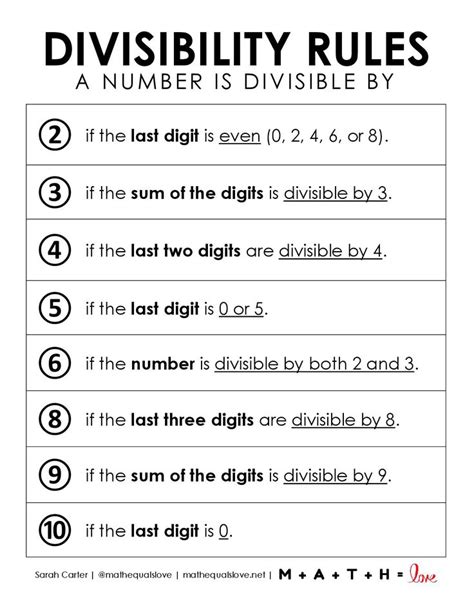
Unlocking n*k Divisibility by 4: The Real Rules RevealedWhenever we dive into the fascinating world of numbers,
divisibility rules
are always a hot topic, right? They’re super handy shortcuts that help us figure out if one number can be perfectly divided by another without any pesky remainders. Today, guys, we’re tackling a really interesting and often misunderstood statement about
divisibility by 4
, specifically when we’re dealing with the product of two numbers,
n
and
k
. You might have heard something like, “
if n times k (n*k) is divisible by 4, then n is divisible by 4 or k is divisible by 4
.” Sounds logical, doesn’t it? It feels like it should be true, especially if you’re thinking about prime numbers or simpler divisibility rules, but here’s the kicker: _this statement is actually false!_Yeah, I know, mind blown! This common misconception trips up a lot of people, so we’re going to unravel the true mechanics behind
n*k divisibility by 4
. We’re going to explore
why
that initial statement doesn’t always hold water and, more importantly, what the
actual
rules are for a product to be perfectly divisible by 4. Understanding this isn’t just about passing a math test; it’s about building a solid foundation in number theory, helping you think critically about mathematical statements, and equipping you with the right tools for problem-solving. We’ll break down the concepts into easy-to-digest chunks, using examples that make everything crystal clear. So, if you’ve ever wondered about the ins and outs of
divisibility by 4
for products, or if you’re just curious to learn some cool number secrets, stick around! This article is packed with high-quality content designed to give you valuable insights. We’ll chat like we’re just hanging out, making sure every concept is super clear and engaging. Get ready to boost your math brain, because by the end of this, you’ll be a pro at spotting
n*k divisibility by 4
like it’s second nature. Let’s get this divisibility party started and uncover the
real
rules that govern how numbers interact when it comes to being a multiple of four. It’s truly
fascinating
stuff once you see the full picture, and you’ll realize why getting this nuanced understanding is so important for anyone who loves numbers or needs to apply these principles in various fields. Let’s make sure we’re all on the same page and really
get
this concept once and for all. It’s going to be a fun and enlightening journey, so buckle up!## Unraveling the Mystery: The Divisibility of n*k by 4Let’s cut straight to the chase and tackle that widely believed, yet incorrect, statement head-on: the idea that “
if the product of two numbers,
n*k
, is divisible by 4, then
n
must be divisible by 4 or
k
must be 4.
” At first glance, this seems so intuitive, doesn’t it? Many people tend to generalize rules they know for prime numbers. For instance, if
n*k
is divisible by 5 (a prime number), then
n
must be divisible by 5 or
k
must be divisible by 5. That rule is absolutely true for prime numbers! But here’s the crucial difference, guys: 4 is
not
a prime number. It’s a composite number, meaning it can be factored into smaller prime numbers, specifically
2 * 2
. And this, my friends, is where the whole scenario changes and why our initial statement often leads us astray. The fact that 4 has these twin factors of 2 is the key to unlocking the true
n*k divisibility by 4
rules.To illustrate this point perfectly and bust that myth right open, let’s use a super simple counterexample. Imagine
n = 2
and
k = 2
. If we calculate their product,
n*k = 2 * 2 = 4
. Is 4 divisible by 4? Absolutely, yes! Now, let’s check the second part of the original statement: is
n
divisible by 4? No, 2 is not divisible by 4. Is
k
divisible by 4? No, 2 is also not divisible by 4. So, we have a clear situation where
n*k
is
divisible by 4, but
neither
n
nor
k
individually is divisible by 4. See? The statement is proven false by this simple example.This means that the condition for
n*k divisibility by 4
isn’t as straightforward as just one of the factors (n or k) being a multiple of 4. We need to look at the
prime factors
of n and k, specifically how many factors of 2 they collectively contribute to the product. For a number to be divisible by 4, its prime factorization must include
at least two factors of 2
. Think about it: 4 =
2 * 2
. So, any number that’s a multiple of 4 (like 8, 12, 16, 20) will always have at least two 2s in its prime factorization (e.g., 8 =
2 * 2 * 2
, 12 =
2 * 2 * 3
, 16 =
2 * 2 * 2 * 2
).When we multiply
n
and
k
to get
n*k
, we’re essentially combining their prime factors. If
n*k
needs to have at least two factors of 2, these factors can come from
n
, from
k
, or from a combination of both. This insight is
crucial
for understanding the true
divisibility by 4
rule for products. It’s not about one number alone carrying the entire burden of being a multiple of 4; it’s about their combined power. We’ll delve into the specific scenarios in the next sections, showing you exactly how these factors of 2 play out. But for now, remember this: the
n=2, k=2
example is your go-to friend for dispelling the myth and understanding that 4’s composite nature makes its divisibility rule for products a bit more nuanced than those for prime numbers. It’s all about the collective prime factors, guys, and once you grasp that, you’ll be able to confidently determine
n*k divisibility by 4
every single time, without falling for those common mathematical traps. It truly empowers you to look beyond the surface and understand the deeper mechanics of numbers. It’s not just about memorizing rules, it’s about
comprehending
why those rules exist and when they apply. So keep that prime factorization in mind as we move forward!## Diving Deeper into Divisibility Rules: Understanding Factors of 4Alright, let’s really dig into what it
truly
means for a number to be
divisible by 4
. Forget the old misconceptions for a moment, and let’s get down to the brass tacks of prime factorization, which is the cornerstone of understanding
divisibility by 4
. When we say a number is “divisible by 4,” what we’re
really
saying is that it’s a multiple of 4, or that when you divide it by 4, you get a whole number with no remainder. And what is 4, in its most fundamental form? It’s
2 * 2
. This means, for any integer to be
divisible by 4
, its prime factorization
must
contain at least two factors of 2. No more, no less, just two or more. If it has less than two 2s, it simply cannot be a multiple of 4. Simple as that!Think of it like building with LEGOs. To build a “4-unit,” you absolutely need two “2-unit” bricks. If you only have one “2-unit” brick, you can’t make a “4-unit.” You might make a “2-unit” structure, but not a “4-unit” one. This analogy, guys, is super helpful for visualizing prime factors. When we talk about
n*k divisibility by 4
, we’re essentially looking at the combined “LEGO bricks” of
n
and
k
. When you multiply
n
and
k
, you’re effectively pooling all their prime factors together. So, if
n
has some prime factors and
k
has some prime factors, their product
n*k
will have
all
of those prime factors combined. For
n*k
to be divisible by 4, this combined pool of prime factors
must
contain at least two factors of 2. Now, where can these two factors of 2 come from? This is where the different scenarios for
n*k divisibility by 4
become clear, and it’s also where the original false statement falls apart. There are a few ways for
n
and
k
to collectively provide those two essential factors of 2. First off, if
n
itself is
divisible by 4
, that means
n
already contains those two factors of 2 (e.g.,
n = 4a = 2 * 2 * a
). In this case,
n*k
will definitely be
(2 * 2 * a) * k
, which clearly shows it’s a multiple of 4. So, if
n
is a multiple of 4, then
n*k
is a multiple of 4. The same logic applies if
k
is
divisible by 4
. If
k = 4b = 2 * 2 * b
, then
n*k = n * (2 * 2 * b)
, which again, is certainly a multiple of 4. These two scenarios are what many people intuitively focus on, and they are indeed correct.However, here’s the
critical
third scenario for
n*k divisibility by 4
– the one that most people miss and that directly disproves our initial false statement. What if
n
isn’t divisible by 4, and
k
isn’t divisible by 4, but
both
n
and
k
are even numbers? If
n
is even, it means
n
contains at least
one
factor of 2 (e.g.,
n = 2a
). If
k
is also even, it means
k
contains at least
one
factor of 2 (e.g.,
k = 2b
). When you multiply these two together,
n*k = (2a) * (2b) = 4ab
. Voila! The product
n*k
now explicitly contains two factors of 2 (represented by the 4), making it undeniably
divisible by 4
. This is the game-changer! This is the scenario we saw with
n=2
and
k=2
. Neither 2 nor 2 is divisible by 4, but their product
2 * 2 = 4
is
divisible by 4. So, the true condition isn’t an “or” between “n is divisible by 4” and “k is divisible by 4.” It’s actually a broader statement about the combined count of factors of 2. You need at least two 2s, and those 2s can come from
n
, from
k
, or from one 2 in
n
and one 2 in
k
. This comprehensive understanding of factors of 4, especially the role of those two prime factors of 2, is paramount to truly mastering
n*k divisibility by 4
and avoiding those common mathematical blunders. It’s about seeing the full picture of prime factorization and how numbers build upon each other. So, now you know the real secret, and you’re already one step ahead, guys!### Case Study 1: When n or k is a multiple of 4Let’s dive into our first case study, which covers the most straightforward scenarios for
n*k divisibility by 4
. These are the situations where one of the numbers,
n
or
k
, already takes care of the divisibility by 4 on its own. This is probably the part of the rule that most people instinctively get right, and it aligns with a part of the original, flawed statement. So, when is it that simple? It’s when either
n
or
k
is
already
a multiple of 4.If
n
is a multiple of 4, it means we can write
n
as
4 * something
. Let’s say
n = 4m
, where
m
is any whole number. For example,
n
could be 4, 8, 12, 16, and so on. Now, if we calculate the product
n*k
, we substitute
n
with
4m
. So,
n*k = (4m) * k
. Rearranging that, we get
4 * (m*k)
. Look at that, guys! The product
n*k
clearly has a factor of 4 in it, which means
n*k
is absolutely
divisible by 4
. The value of
k
doesn’t even matter in this scenario –
k
could be any integer, odd or even, large or small, and the product will still be a multiple of 4.For instance, let’s take
n = 8
(which is
4 * 2
) and
k = 3
. Here,
n
is a multiple of 4. Our product
n*k = 8 * 3 = 24
. Is 24 divisible by 4? Yes,
24 / 4 = 6
. Perfect! Another example:
n = 12
(which is
4 * 3
) and
k = 5
.
n*k = 12 * 5 = 60
. Is 60 divisible by 4? You bet,
60 / 4 = 15
. See how simple that is? It’s a guaranteed win for
n*k divisibility by 4
if one of the numbers itself is already a multiple of 4.The same logic applies if
k
is the one that’s a multiple of 4. If
k = 4p
(where
p
is any whole number), then
n*k = n * (4p) = 4 * (n*p)
. Again, we clearly see a factor of 4, making
n*k
divisible by 4
. For example,
n = 7
and
k = 20
(which is
4 * 5
).
n*k = 7 * 20 = 140
. Is 140 divisible by 4? Absolutely,
140 / 4 = 35
. So, whether it’s
n
or
k
that’s the multiple of 4, the outcome for the product
n*k
is the same: it will always be divisible by 4.This case study highlights the most straightforward path to
n*k divisibility by 4
. It essentially says, “if one of the numbers brings all the ‘2-factors’ needed for 4 to the party, then the product is good to go, regardless of what the other number brings (as long as it’s an integer).” This part of the rule is easy to grasp because it feels very direct. It’s like if you need two pairs of socks, and one person shows up with two pairs already, you’re all set! The other person can show up with zero, one, or a hundred pairs, and your requirement is still met. However, as we discussed earlier, this isn’t the
only
way for
n*k divisibility by 4
to occur, and it’s important not to assume it is. The next case study will reveal the situation that truly challenges the initial false statement and shows the power of shared responsibility in prime factorization. So, while this scenario is simple and correct, it’s only one piece of the puzzle, and understanding the
full
picture is what makes you a true divisibility master! Remember, knowing
why
these rules work, thanks to prime factorization, is way more powerful than just memorizing them.### Case Study 2: The “Tricky” Scenario – When Both n and k are Even, but Not Multiples of 4Alright, guys, this is where the real fun begins and where we fully dismantle that pesky myth about
n*k divisibility by 4
. This is the
tricky scenario
where both
n
and
k
are even numbers, but
neither
of them is individually a multiple of 4. This is the crucial point that most people miss, and it’s what truly distinguishes the divisibility rule for 4 from those for prime numbers. Let’s remember our core principle: for a number to be
divisible by 4
, it needs to have at least two factors of 2 in its prime factorization. So, if
n
isn’t a multiple of 4, and
k
isn’t a multiple of 4, how can their product
n*k
still be divisible by 4?The answer lies in their shared factors of 2! If
n
is an even number but
not
a multiple of 4, it means
n
has
exactly one
factor of 2 in its prime factorization. For instance,
n
could be 2, 6, 10, 14, 18, etc. We can represent such an
n
as
2 * a
, where
a
is an odd number. Similarly, if
k
is also an even number but
not
a multiple of 4, then
k
also has
exactly one
factor of 2 in its prime factorization. We can represent
k
as
2 * b
, where
b
is an odd number.Now, let’s look at their product,
n*k
. If
n = 2a
and
k = 2b
, then
n*k = (2a) * (2b)
. Using the associative and commutative properties of multiplication (basically, moving numbers around), we can rewrite this as
2 * 2 * a * b
. And what is
2 * 2
? It’s 4! So,
n*k = 4 * (a*b)
.Boom! Just like that, the product
n*k
explicitly contains a factor of 4, which means
n*k
is undeniably
divisible by 4
. This is the magic, guys! Each number
n
and
k
contributes one factor of 2, and when combined in the product, they form the two factors of 2 needed for divisibility by 4.Neither
n
nor
k
individually carried the full burden of being a multiple of 4, but together, they did the job perfectly.Let’s throw in some examples to make this crystal clear.The classic example, which we used to bust the myth, is
n = 2
and
k = 2
. Here,
n
is even but not a multiple of 4.
k
is also even but not a multiple of 4. Their product
n*k = 2 * 2 = 4
. And 4
is
divisible by 4
.Another great one: Let
n = 6
and
k = 10
. Is 6 divisible by 4? No. Is 10 divisible by 4? No. But let’s look at their prime factors:
6 = 2 * 3
and
10 = 2 * 5
. When we multiply them,
n*k = (2 * 3) * (2 * 5) = 2 * 2 * 3 * 5 = 4 * 15 = 60
. Is 60 divisible by 4? Yes,
60 / 4 = 15
.Perfect! Here,
n
contributed one factor of 2, and
k
contributed one factor of 2, and together they made the product divisible by 4.One more for good measure:
n = 14
and
k = 18
. Neither is a multiple of 4.
14 = 2 * 7
,
18 = 2 * 9
. Their product
n*k = (2 * 7) * (2 * 9) = 2 * 2 * 7 * 9 = 4 * 63 = 252
. Is 252 divisible by 4? Yes,
252 / 4 = 63
.This scenario is absolutely key to understanding
n*k divisibility by 4
accurately. It’s not just about one number being a powerhouse; it’s about the collective contribution of prime factors. So, the true rule becomes: for
n*k
to be divisible by 4, you need at least two factors of 2 distributed between
n
and
k
. This can happen if
n
has both (i.e.,
n
is a multiple of 4),
k
has both (i.e.,
k
is a multiple of 4), or if each of them contributes one (i.e., both
n
and
k
are even but not multiples of 4). Mastering this particular case study solidifies your understanding and makes you an expert in predicting
divisibility by 4
for products. It really highlights the importance of getting into the nitty-gritty of prime numbers and their roles in composite numbers.## Why This Distinction Matters: Avoiding Common Math PitfallsNow that we’ve thoroughly explored the nuances of
n*k divisibility by 4
, you might be thinking, “Okay, cool, but why is it such a big deal to understand this distinction?” Well, guys, understanding this isn’t just about scoring extra points on a math quiz (though it definitely helps!). It’s about developing a precise, critical, and analytical approach to mathematics, which is a skill that extends far beyond the classroom. Avoiding these common math pitfalls, like the one we just debunked, is super important for several reasons, and it truly enhances your overall mathematical prowess.First and foremost, it highlights the importance of
mathematical precision
. In math, every word, every operator, and every condition matters. The difference between “n is divisible by 4
or
k is divisible by 4” and “n has at least two factors of 2
or
k has at least two factors of 2
or
n has one factor of 2 and k has one factor of 2” might seem subtle, but it’s the difference between a false statement and a true, comprehensive understanding of
divisibility by 4
. Being precise in your mathematical thinking helps you avoid drawing incorrect conclusions in more complex problems, whether you’re dealing with algebra, number theory, or even coding algorithms. A small logical error can snowball into much larger, incorrect results down the line, and that’s something we definitely want to avoid!Secondly, understanding the true
n*k divisibility by 4
rule trains your mind to look beyond superficial patterns and delve into the
underlying structure
of numbers. It encourages you to think in terms of prime factorization, which is one of the most fundamental concepts in number theory. Prime factorization is like the DNA of numbers; it tells you everything you need to know about a number’s divisibility, its greatest common divisor, its least common multiple, and so much more. By understanding that 4 is
2 * 2
, and therefore requires two factors of 2 for divisibility, you’re not just memorizing a rule; you’re understanding
why
the rule works. This deeper analytical skill is invaluable for solving problems that don’t just involve simple multiplication but require a breakdown of factors.Third, this specific example serves as a fantastic lesson in the dangers of
overgeneralization
. As we noted, the “if
a*b
is divisible by
p
(a prime), then
a
is divisible by
p
or
b
is divisible by
p
” rule is perfectly valid for prime numbers
p
. It’s tempting to assume that this rule applies to all numbers, but our exploration of
divisibility by 4
clearly shows that it doesn’t. Composite numbers behave differently because they are made up of multiple prime factors. Learning to identify when a rule applies and when it doesn’t – and, most importantly,
why
– is a critical aspect of mathematical maturity. This lesson isn’t confined to number theory; it’s a general principle that applies to logic, scientific reasoning, and even everyday problem-solving.Finally, mastering concepts like
n*k divisibility by 4
boosts your confidence and makes you a more effective problem-solver. When you truly understand the mechanics, you can approach new problems with a stronger foundation. You’ll be able to quickly verify your answers, spot errors, and even develop your own mental shortcuts based on solid mathematical principles. This high-quality content about a seemingly small detail in number theory actually equips you with powerful cognitive tools. So, while it might seem like a niche topic, grasping the correct
divisibility by 4
rule for products is a significant step towards becoming a more thoughtful, precise, and effective mathematical thinker. It’s about moving from simply knowing
what
to do to deeply understanding
why
you’re doing it, which, trust me, makes all the difference in the world when you’re tackling more complex challenges. It truly empowers you, guys, to approach math with a newfound clarity and confidence.## Practical Tips for Spotting Divisibility by 4Now that we’ve thoroughly debunked the common misconception and truly understand the ins and outs of
n*k divisibility by 4
, let’s equip you with some practical tips. These aren’t just theoretical insights; these are actionable strategies that you can use to quickly and confidently determine divisibility by 4, whether you’re dealing with a single number or the product of two. Mastering these techniques will make you a pro at spotting
divisibility by 4
without a hitch, saving you time and boosting your accuracy in calculations.First, let’s recap the simple rule for checking if a
single
number is
divisible by 4
. This is your foundational skill, guys. A number is divisible by 4 if the number formed by its last two digits is divisible by 4. For example, consider the number 3,472. The last two digits form the number 72. Is 72 divisible by 4? Yes,
72 / 4 = 18
. So, 3,472 is divisible by 4. How about 1,538? The last two digits form 38. Is 38 divisible by 4? No,
38 / 4 = 9
with a remainder of 2. So, 1,538 is
not
divisible by 4. This simple trick works because 100 is divisible by 4 (
100 / 4 = 25
), so any multiple of 100 is also divisible by 4. The divisibility of a larger number by 4 then only depends on the remaining part (the last two digits). Keep this in your mental toolkit for quick checks!Now, let’s get to the core of
n*k divisibility by 4
. We’ve learned that for a product
n*k
to be divisible by 4, you need a combined total of at least two factors of 2 from
n
and
k
. This gives us a clear strategy for checking products:1.
Check if
n
is divisible by 4
: Use the last two digits rule. If
n
is a multiple of 4, then
n*k
is definitely divisible by 4, no matter what
k
is (as long as
k
is an integer). You’re done! For example, if
n = 28
(28 is divisible by 4), then
28 * 17
will be divisible by 4.2.
If
n
isn’t divisible by 4, check if
k
is divisible by 4
: Again, use the last two digits rule. If
k
is a multiple of 4, then
n*k
is definitely divisible by 4. You’re done! For example, if
n = 5
and
k = 36
(36 is divisible by 4), then
5 * 36
will be divisible by 4.3.
If neither
n
nor
k
is divisible by 4, check if
both
are even
: This is our tricky scenario! If both
n
and
k
are even numbers, but neither is a multiple of 4, then their product
n*k
will still be divisible by 4
. Why? Because each contributes one factor of 2. You can tell if a number is even simply by looking at its last digit: 0, 2, 4, 6, or 8. For instance, if
n = 6
(even, not mult of 4) and
k = 10
(even, not mult of 4), their product
6 * 10 = 60
is
divisible by 4.Another example:
n = 14
and
k = 22
. Both are even.
14 = 2 * 7
,
22 = 2 * 11
. Neither is a multiple of 4. But their product
14 * 22 = 308
. Is 308 divisible by 4? The last two digits form 08, and 08 is divisible by 4. Yes! So,
308 / 4 = 77
.This three-step process gives you a foolproof method for quickly determining
n*k divisibility by 4
. It covers all possible scenarios and ensures you don’t fall for the common trap of only checking if
n
or
k
is a multiple of 4. By applying these practical tips, you’ll not only quickly identify
divisibility by 4
but also reinforce your understanding of prime factorization and the true nature of composite number divisibility. Remember, practice makes perfect, so try these out with different numbers, and you’ll be a divisibility master in no time! These simple yet powerful methods will give you a significant edge in any mathematical situation requiring quick divisibility checks. It’s truly about working smarter, not harder, guys!## Conclusion: Mastering Divisibility by 4 Together!Wow, guys, what a journey through the world of
n*k divisibility by 4
! We started by tackling a common misconception head-on, the idea that if
n*k
is divisible by 4, then
n
or
k
must be individually divisible by 4. We decisively proved that statement false using simple counterexamples, showing that the composite nature of 4 (as
2 * 2
) makes all the difference. Remember, the key takeaway is that for any product
n*k
to be
divisible by 4
, the combined prime factors of
n
and
k
must include
at least two factors of 2
.We broke down the different scenarios that lead to
divisibility by 4
: either
n
is already a multiple of 4,
k
is already a multiple of 4, or – and this is the crucial part – both
n
and
k
are even numbers (each contributing one factor of 2 to the product). This nuanced understanding is incredibly valuable, not just for number theory, but for fostering precise mathematical thinking and avoiding common pitfalls in problem-solving. This high-quality content has hopefully shown you why precision and a deep dive into prime factorization are so important.We also armed you with practical tips, like checking the last two digits for single numbers, and a three-step process for products. Now, you’re not just guessing; you’re applying a solid, logical framework to confidently determine
n*k divisibility by 4
every single time. By mastering these rules, you’ve gained a deeper appreciation for the mechanics of numbers and honed your analytical skills. So, go forth, my fellow number enthusiasts, and apply your newfound knowledge! You’re now equipped to tackle divisibility by 4 with confidence and precision, and that’s a truly awesome thing. Keep exploring, keep learning, and remember that every little piece of mathematical understanding makes you a stronger, smarter problem-solver. Great job today, guys! It’s been a blast mastering this together!
